Our kids are ahead of us on AI. That’s exactly why they need us.
They pick up new AI tools faster than we do. But speed with a tool is not the same as judgment about it, and judgment is something we can teach.
I build AI systems for a living. I’m also a parent. For a while those two parts of my life stayed separate. Then I started paying attention to how my friends’ kids use AI, and they stopped being separate.
The kids weren’t doing anything dramatic. They were doing homework with it, asking it for stories, and chatting with it the way they’d chat with a friend. What struck me was how natural it was for them, and how little the adults around them knew about it.
That gap is why I’m running a free session for parents, and why I’m writing this. Nobody handed us a manual for this part of parenting, so we have to write one together.
of kids aged 9 to 17 say they’ve used AI for schoolwork. More than half say no parent has talked to them about using it safely.
2026 survey reported by Education Weekof teens have tried AI companions. About a third have talked to one about something serious instead of a person.
Common Sense MediaA confession: our kids are ahead of us
Let’s be honest with each other. Most of us heard about ChatGPT on the news. Our kids heard about it from each other. They find the new app, the new trick and the workaround long before we find the settings menu.
Our kids are AI natives. We’re AI immigrants with a phrasebook. That can feel uncomfortable, especially for parents who are used to knowing more than their children about the world.
Here’s the good news. Being behind on the tools doesn’t put us behind on what matters. Kids know which buttons to press. They don’t yet know when to trust an answer, what not to share, or when a chat should become a conversation with a real person. That part is ours to teach, and we already have the life experience to teach it.
You don’t need to be ahead of your kids on technology. You need to be ahead of them on judgment.
Confident is not the same as correct
The second thing every parent should know is simple: AI is often wrong, and it rarely sounds wrong.
AI tools build answers from patterns in what they were trained on. When they don’t know something, they often fill the gap with something that sounds reasonable. Experts call this hallucination. The tool doesn’t announce that it’s guessing. It uses the same calm, confident tone whether it’s right or wrong.
Try a simple test with your child: ask an AI how many moons Saturn has. Astronomers keep finding new ones, and the confirmed count reached 285 in March 2026. Some tools will confidently give you an older number. Now imagine that answer copied straight into a science project.
The same thing happens with invented book titles, made-up quotes and sources that don’t exist. Adults usually sense when something is off. Children tend to trust a confident voice, especially one that’s friendly, patient and always available. That’s why this needs a conversation, not just a setting.
Six conversations to have at home
Settings protect a child for a while. Conversations protect them everywhere: at school, at a friend’s house, on any app. These are the six I share with parents. Try one a week.
- “AI can sound friendly, but it doesn’t have feelings.”It predicts kind words. It doesn’t feel them.
- “Use AI to help your brain, not replace it.”Ask for a hint, try it yourself, then explain the answer back.
- “A confident answer can still be wrong.”Check one important fact in a book or on a trusted site.
- “Share only what the task needs.”An invitation needs blanks to fill in, not your home address.
- “Private from AI doesn’t mean secret from us.”If anything online scares you, pressures you or says “keep this secret,” tell us. You won’t be in trouble.
- “Ask before connecting, paying or publishing.”One tap can link an account, buy credits or share a project with the world.
Start this week
- Have conversation 2 during homework. It fits naturally into a moment you already share.
- Check your teen’s ChatGPT settings. If you’ve linked accounts, “Improve the model for everyone” is on by default for teens. Turn it off so their chats aren’t used for training.
- Catch AI being wrong together. Ask it something you already know the answer to, and see what it gets wrong. Kids remember that moment far longer than any lecture.
None of this requires you to become a tech expert. It requires you to stay curious, ask questions, and keep the conversation going. Your kids may be ahead of you on the tools. They still need you for everything else.
Parenting in the Age of AI
One hour on Google Meet. No technical background needed.
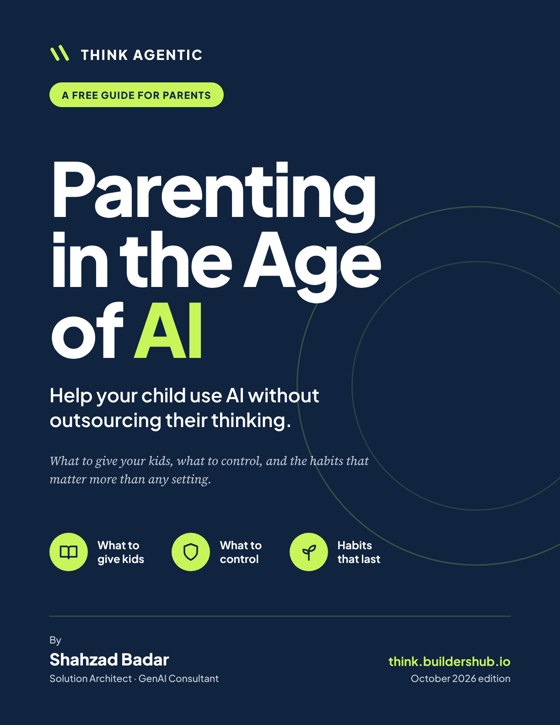
Parenting in the Age of AI
The six conversations, every setting step by step, and a Family AI Agreement to sign together.
Get the free guide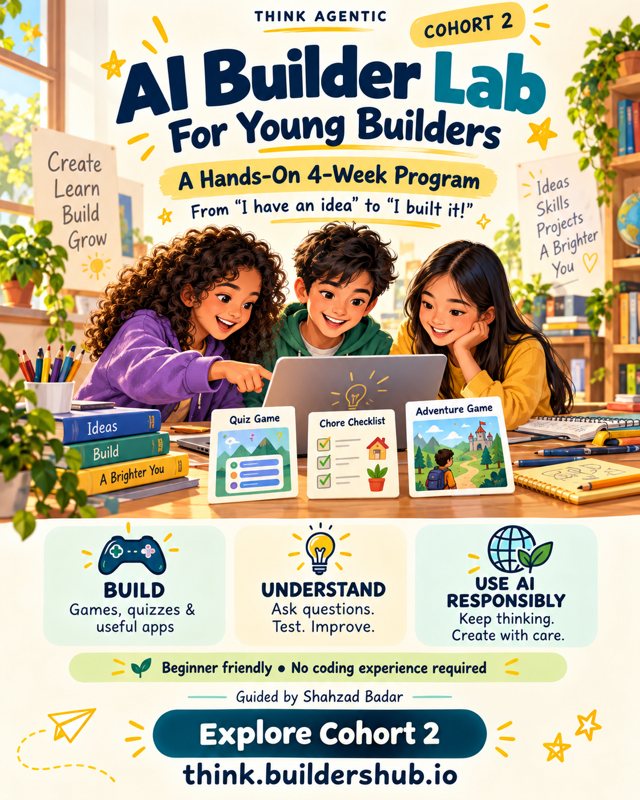
AI Builder Lab for Young Builders
A hands-on 4-week program where kids build games, quizzes and useful apps. Beginner friendly, no coding needed.
Explore Cohort 2