Join live on Google Meet
Saturday, Sep 12 · 11:00 AM to 12:00 PM ET · 60 minutes · Free
https://meet.google.com/xim-iajy-smfNo setup needed. Open the link, listen, ask questions.
think.buildershub.io/series/build-with-ai/season-1/build-ai-agents-with-n8n
What is an AI agent?
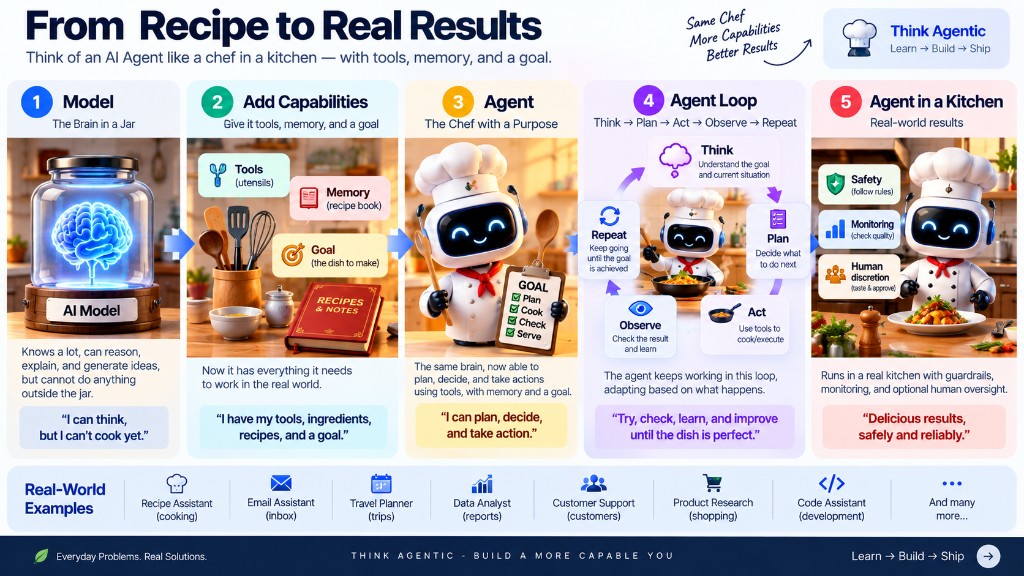
An agent is made of four parts
Next: the four parts, then the loop. If this is new, Episode 01 is one scan away.
Four parts. One job.
The model thinks. Instructions set the rules. Context is what it can see. Tools are what it can do.
Model
The brain. It reads the goal, chooses the next step, and writes the words.
Instructions
The job description. Tone, boundaries, when to stop, when to ask you.
Context
What it can see right now — the request, memory of prior steps, files, the current state.
Tools
Hands. Search, write, send, look something up. Without tools it can only talk.
Parts describe the agent. The loop is how it uses them.
The agent loop
Reason → Act → Observe → Repeat. Same loop we walked in Episode 01.
Reason
Look at the goal and decide the next step.
Act
Use a tool — search, write, send, look something up.
Observe
Read what came back. Did it help? Did it fail?
Repeat
Decide again until the goal is met — or it must ask you.
The harness is the kitchen
The model is the chef. The harness is everything around her: tools, rules, context, and what she is allowed to touch.
ChatGPT
Mostly a table and a conversation. She can talk. She has almost no stove.
Claude Code
A workshop. Files, terminal, git — Episode 02’s kitchen.
n8n
A line that can serve. Sheets, Gmail, LinkedIn — and a rule: ask before you plate.
Same chef. Studio apartment, food truck, restaurant. The talent did not change. The knives, the fridge, and the house rules did. That whole setup is the harness.
We are not hiring a smarter chef today. We are building the kitchen.
n8n is the harnessGo back to Episode 01 — The Agentic Trail
Chatbots, assistants, workflows, agents, and when not to build one. Recording and slides are on the episode page.
Scan for the recording
Or open the episode page on your phone. We stay here to build. That session is the map.
Today we connect that loop to n8n — and make it act in the real world.
We had workflows
For example
A recipe. Chop, sear, simmer, plate — the same steps in the same order, and the same dish every time.
When a workflow runs by itself
That's automation.
The rice cooker on a timer. You load it at seven and walk away. Nobody is in the kitchen, and it still cooks only what it was set to cook.
What if different things should happen?
A note pinned to the recipe: if a guest is vegetarian, use paneer instead of chicken. The cook follows it — but you wrote it last week.
Now let's add AI
The model can
A cook who can taste. She tells you the sauce is too salty, and she is genuinely useful. She still does not decide what is for dinner.
Now give the AI a goal and tools
You tell a chef: dinner for six at eight, one vegetarian. She checks the fridge, plans the menu, swaps basil for mint when the shop is out, and asks you — chaye or coffee? Then she chooses: chop the ginger, or grind it fresh.
A recipe tells you what to do. A goal tells you what to achieve.
Agent or not?
Four scenarios, one at a time. For each one, pick the label that fits it.
A · Workflow
We run it
B · Automation
It runs itself
C · AI-powered
AI does one job inside it
D · Agentic
It decides
Four scenarios
It researches, decides whether an image would help, writes the content, picks its tools, and asks before publishing. D · Agentic
So where does n8n fit?
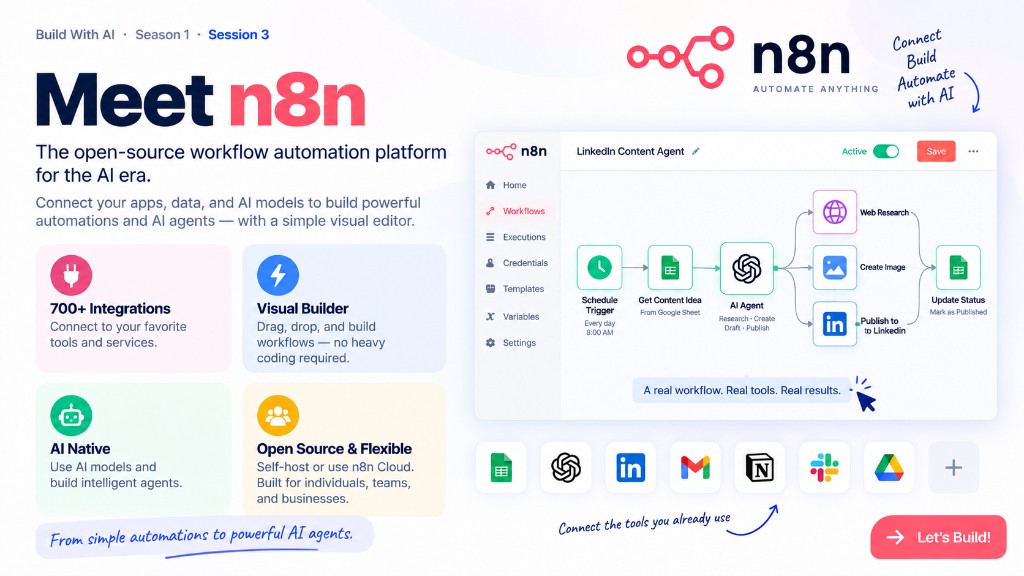
Connect AI to the real world.
n8n started as a workflow automation platform. Today it also gives us AI and agent-building capabilities.
A visual canvas where you connect apps and let AI act inside them
Visual canvas
You drag boxes and connect them. You can see every step and the data that came out of it.
400+ connections
Gmail, Sheets, Slack, LinkedIn, databases, and any API you can call.
AI built in
An AI Agent node that can pick from those same connections as its tools.
Cloud or your own server
Source available. Start on their cloud, self-host later if you want the control.
The same canvas carries a simple automation and a full agent.
From workflow to agent
1 · Workflow
We control the path.
2 · Workflow + agent
AI gets decision-making responsibility inside the process.
3 · Agent-first
Image
We give it a goal, instructions and tools.
Today we'll see both sides of n8n — not pretend every workflow is an agent.
The building blocks of n8n
Triggers
Start the workflow.
Action nodes
Do something in another system.
AI / agent nodes
Understand, reason, generate or decide.
Tools
Capabilities an agent can choose to use.
Control / logic
Control how execution moves.
Data / transformation
Prepare information between steps.
Nodes build the system. Tools give the agent capabilities.
The same problem, built two ways
Version 1 · Automation
We decide everything.
Version 2 · Agent
The agent decides what it needs.
Which agent should we explore?
Career Navigator
Resume → opportunities → fit → gaps → next step
Lead Hunter
Company → research → qualify → decide → outreach
Content Agent
Idea → research → content → visual? → publish?
Build your first agent
Goal
What should it accomplish?
Instructions
How should it behave?
Model
What intelligence powers it?
Tools
What can it actually do?
Test
Does it make good decisions?